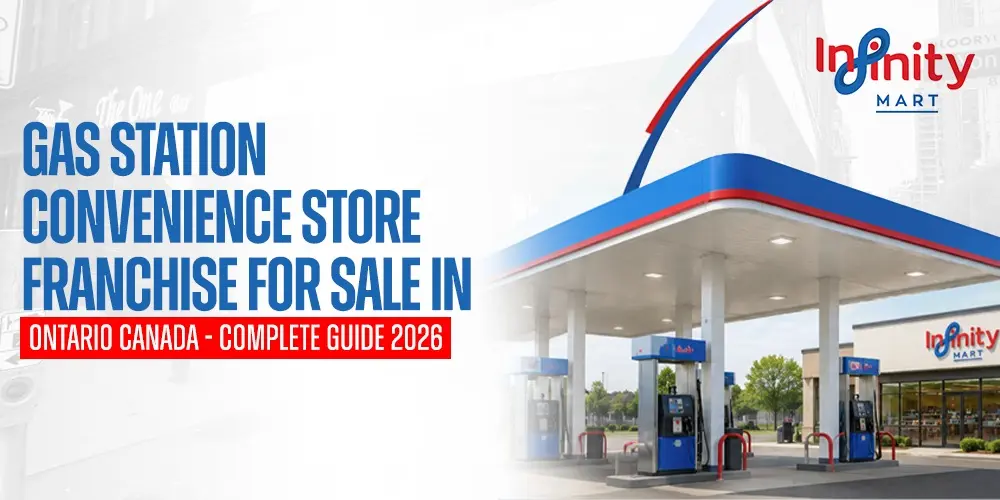
Gas Station Convenience Store Franchise for Sale in Ontario, Canada — Complete Guide 2026
Introduction:
Ontario is home to more than 15.8 million residents, according to Statistics Canada’s 2024 population estimates, making it the most populous province in the country. It accounts for the single largest share of Canada’s GDP and contains some of North America’s most heavily trafficked highway corridors, including the 401, which handles upwards of 420,000 vehicles per day near Toronto. For investors evaluating a gas station convenience store franchise for sale in Ontario, this combination of population density, commuter traffic, and economic activity creates one of the most reliable demand environments in Canada.
This guide covers everything a serious investor needs to evaluate before committing capital: total investment costs, revenue expectations, top locations, legal requirements under Ontario’s franchise disclosure laws, environmental compliance obligations, and what to look for in a franchisor. Whether you are a first-time buyer or an experienced multi-unit operator, the Ontario market in 2026 offers compelling opportunities, if you know where to look and what questions to ask.
Why Is Ontario the Best Province for a Gas Station Convenience Store Franchise?
Several structural factors make Ontario consistently outperform other Canadian provinces for this category of retail investment.
Highway Infrastructure and Vehicle Traffic
Ontario’s highway network is among the densest in North America. The 401, the province’s primary east-west corridor, is one of the busiest highways in the world by traffic volume. Highways 400, 407, QEW, and the 417 (Ottawa) together handle tens of millions of vehicle trips annually. According to the Ontario Ministry of Transportation’s 2023 Traffic Volume Report, average annual daily traffic on key 400-series highways ranges from 80,000 to 420,000 vehicles. For a gas station convenience store, this volume translates directly into fuel customers and in-store foot traffic, the core revenue drivers of the business model.
Population Growth and Urban Expansion
Ontario’s population has grown by more than 600,000 residents in the past two years, driven by international immigration and inter-provincial migration. The Greater Toronto Area alone added over 300,000 people between 2021 and 2024, according to Statistics Canada’s Census and population projection data. Suburban communities such as Brampton, Mississauga, Vaughan, and Markham continue to expand rapidly, creating new residential corridors with strong demand for nearby convenience and fuel retail.
Multiple Revenue Streams Beyond Fuel
A modern Ontario gas station convenience store is not simply a fuel operation with a small retail counter. Today’s locations generate income across multiple channels: in-store convenience sales, lotto commissions, beer and wine retail (where LCBO agency agreements are in place), ATM fees, car wash, and, increasingly, Bitcoin ATM and food service. This diversification makes the business model more resilient to fuel margin fluctuations and creates stronger per-site economics than most single-category retail formats.
How Much Does a Gas Station Convenience Store Franchise Cost in Ontario?
Investment levels vary considerably depending on location, store format, and whether you are entering an existing operation or building new. Here is a realistic breakdown based on current Ontario market conditions.
Total Investment Range
Investment Tier | Estimated Total (CAD) | Typical Format |
|---|---|---|
Entry Level | $185,000 – $350,000 | Existing location, smaller footprint, co-branded fuel |
Mid-Range | $350,000 – $600,000 | New buildout, mid-size store, branded fuel integration |
Full-Scale | $600,000 – $1,000,000+ | Large format, new construction, high-traffic highway site |
Infinity Mart’s franchise model offers an estimated total investment of $185,000 to $485,500 CAD, making it one of the more accessible entry points in the Ontario market. This includes a $30,000 one-time franchise fee, leasehold improvements, fixtures and equipment, initial inventory, signage, professional fees, and working capital reserves.
Detailed Startup Cost Breakdown — Infinity Mart Model
Cost Category | Estimated Range (CAD) |
|---|---|
Franchise Fee (one-time) | $30,000 |
Leasehold Improvements | $50,000 – $150,000 |
Fixtures, Equipment & POS System | $50,000 – $150,000 |
Initial Inventory | $35,000 – $100,000 |
Signage and Branding | $5,000 – $10,000 |
Professional Fees (Legal, Permits) | $2,500 – $5,000 |
Training & Onboarding | $2,500 |
Working Capital (3–6 months) | $15,000 – $35,000 |
Estimated Total | $185,000 – $485,500 CAD |
Note: Applicable taxes are additional. POS and security system costs may also be additional. Final costs are confirmed when a specific location is identified.
Revenue Potential: What Can an Ontario Location Earn?
According to industry data compiled by the Canadian Convenience Stores Association (CCSA) and CIBC small business sector reports, a well-positioned combined gas station and convenience store in Ontario generates annual revenues between $900,000 and over $3,000,000, depending on fuel volume, in-store performance, and ancillary revenue streams. Key benchmarks to evaluate a site:
- Fuel volume: Strong Ontario locations typically move 3 to 8 million litres annually
- In-store convenience sales: $500,000 to $1,500,000+ per year at healthy sites
- Lotto commissions: A significant recurring revenue driver at high-traffic locations
- Beer and wine: Where LCBO agency agreements apply, alcohol adds meaningful margin
- ATM, Bitcoin, car wash: Passive income with low operational overhead
Ontario Franchise Law: What Every Buyer Must Know Before Signing
Ontario is governed by the Arthur Wishart Act (Franchise Disclosure), 2000, one of the strongest franchise disclosure laws in Canada. Understanding your legal protections before signing any agreement is not optional; it is essential.
The Franchise Disclosure Document (FDD)
Every Ontario franchisor is legally required to provide a prospective franchisee with a Franchise Disclosure Document (FDD) at least 14 days before any agreement is signed or any payment is made. The FDD must include audited financial statements, a complete list of existing franchisees, all material facts about the business, and the full franchise agreement.
Important: Do not waive the 14-day review period. Use this time to retain a franchise lawyer and a CPA to review the FDD independently. This step protects your investment and is standard practice for experienced buyers.
Right to Associate
Under the Arthur Wishart Act, franchisees have the right to form or join a franchisee association, a protection that does not exist in many other jurisdictions. This right cannot be waived by contract.
Where to Learn More
The Ontario government’s official franchise disclosure guidance is available at ontario.ca. The Canadian Franchise Association (CFA) also provides due diligence resources and a directory of franchise lawyers at cfa.ca.
Environmental and Regulatory Requirements for Gas Station Operations in Ontario
This section is frequently overlooked by first-time buyers, and it is one of the most important areas of due diligence for any gas station franchise acquisition in Ontario.
Underground Storage Tanks (USTs) and TSSA Compliance
All fuel storage and dispensing operations in Ontario are regulated by the Technical Standards and Safety Authority (TSSA) under the Fuel Safety Act. Any site with underground storage tanks must comply with TSSA regulations covering tank integrity, double-wall systems, leak detection equipment, and annual compliance inspections. Before purchasing or leasing a gas station site, confirm that all USTs are TSSA-certified and up to current standards.
Phase 1 and Phase 2 Environmental Assessments
Fuel operations carry environmental liability risk. A Phase 1 Environmental Site Assessment (ESA) reviews historical land use and identifies potential contamination concerns. If Phase 1 raises concerns, a Phase 2 ESA involves soil and groundwater testing. Buyers should always obtain a current Phase 1 ESA, and Phase 2 if warranted, before finalizing any purchase or lease agreement. Remediation costs for a contaminated site can run into the hundreds of thousands of dollars.
Ontario Regulation 153/04 — Records of Site Condition
If the property is changing use or ownership involves a Record of Site Condition (RSC) under Ontario Regulation 153/04, additional environmental review requirements apply. Confirm with a qualified environmental consultant whether an RSC is required for your specific transaction.
What Are the Best Locations in Ontario for a Gas Station Convenience Store Franchise?
Location quality is the single most important determinant of long-term profitability in this business. Here is how the major Ontario markets compare.
Market | Strengths | Investor Considerations |
|---|---|---|
Greater Toronto Area | Highest population density, heavy commuter traffic, strong in-store volumes | Higher entry costs, more competition, strong revenue ceiling |
Hamilton & Niagara Region | Growing populations, expanding corridors, lower entry costs than GTA | Solid traffic volumes, good value-to-cost ratio |
Ottawa | Stable government workforce, consistent year-round demand, less seasonal volatility | Lower fuel volumes than GTA corridors but predictable performance |
Highway 401 / 400 Corridors | Highest fuel volumes in the province, strong long-haul and commuter traffic | Lease costs can be high at key interchanges; fuel volume data critical |
Secondary Cities (KW, London, Windsor, Sudbury) | Lower entry costs, growing populations, less competition | Ideal for first-time investors; lower revenue ceiling vs. major corridors |
Franchise vs. Independent: Which Model Makes More Sense in Ontario?
Many investors compare buying an existing independent gas station against joining an established franchise system. The comparison consistently favours the franchise model for most buyers, particularly those without prior fuel retail experience.
Factor | Franchise Model | Independent Ownership |
|---|---|---|
Brand Recognition | Established brand drives immediate traffic | Must build brand from scratch |
Supplier Pricing | National vendor agreements improve margins | Pay individual market rates |
Training | Structured onboarding from day one | Learn entirely on the job |
Marketing Support | Regional and national campaigns | Self-funded, self-managed |
Site Selection | Franchisor analyzes traffic and demographics | Investor bears full risk |
Scalability | Multi-unit growth supported by franchisor | Complex without systems infrastructure |
Risk Level | Lower, systems and support reduce failure rate | Higher, especially for first-time operators |
How to Buy a Gas Station Convenience Store Franchise in Ontario: Step-by-Step
The process from initial inquiry to grand opening typically takes between 3 and 9 months, depending on site availability, lease negotiations, and permit timelines. Here are the key stages.
- Define your budget and investment capacity. Confirm available capital, financing options, and what tier of location you can realistically target.
- Research franchisors operating in Ontario. Evaluate track record, support infrastructure, FDD quality, and existing franchisee references.
- Submit a franchise application. Provide background, investment capacity, and preferred territory or location type.
- Complete the discovery process. Attend an introductory call and discovery meeting. Review the FDD with a franchise lawyer and CPA during the mandatory 14-day period.
- Site selection and approval. Work with the franchisor’s real estate team to identify and evaluate candidate locations based on traffic data, demographics, and lease feasibility.
- Sign the Franchise Agreement and pay the initial franchise fee to secure your territory.
- Complete training and onboarding. Participate in the full training program covering operations, inventory, POS systems, vendor management, and compliance.
- Store buildout and setup. Finalize leasehold improvements, equipment installation, and initial inventory sourcing.
- Grand opening. Launch with franchisor support on-site, marketing activation, and operational guidance.
Also read this article, Convenience Store Franchise Opportunities in Ontario 2026.
Financing Your Ontario Franchise
Several financing options are available to Canadian investors. The Canada Small Business Financing Program (CSBFP), administered by the federal government, provides loan guarantees of up to $1,000,000 for small businesses purchasing equipment, leasehold improvements, or intangible assets, and is commonly used for franchise acquisitions. The Business Development Bank of Canada (BDC) also offers dedicated franchise financing products with flexible repayment terms. Major chartered banks including RBC, TD, Scotiabank, and BMO have franchise lending desks that are familiar with the convenience and fuel retail category.
Infinity Mart: A Modern Gas Station Convenience Store Franchise in Ontario
For investors evaluating the Ontario market in 2026, Infinity Mart represents one of the more accessible and well-structured entry points available. The brand operates as a next-generation convenience store concept, combining everyday essentials, fresh offerings, and modern store design with a flexible format that works in both standalone convenience locations and co-branded gas station environments.
What the Infinity Mart Model Offers
- Estimated total investment: $185,000 – $485,500 CAD, competitive for the Ontario franchise market
- Co-branded fuel formats available with Esso, Shell, Ultramar, Mobil, and Centex
- Beer and wine retail where LCBO agency agreements apply
- 1–2 week hands-on training program covering operations, inventory, POS, compliance, and customer service
- Full turnkey support from site selection and lease negotiation through grand opening
- Ongoing operational, marketing, and vendor support after opening
- Multi-unit ownership options for investors looking to scale
- Available locations across Ontario including GTA, Ottawa, Hamilton, and growing suburban markets
Infinity Mart’s model is built around operational simplicity and franchisee profitability. The brand focuses on right-sized store formats, low overhead, strong vendor terms, and a support system designed to reduce the learning curve for first-time operators while giving experienced investors the infrastructure to scale. Learn more about available Ontario locations at infinitymart.co/convenience-store-franchise-opportunity-ontario/
Frequently Asked Questions
How much does a gas station convenience store franchise cost in Ontario?
Total investment typically ranges from $185,000 to over $1,000,000 CAD, depending on location, size, store format, and whether you are entering an existing operation or building a new one. Infinity Mart’s model starts from $185,000 to $485,500 CAD, which includes the franchise fee, leasehold improvements, fixtures and equipment, inventory, and working capital.
Is a gas station convenience store franchise profitable in Ontario?
Well-located operations in Ontario generate annual revenues between $900,000 and $3,000,000+, with income across fuel, in-store sales, lotto, beer and wine, ATM, and car wash. Profitability is driven primarily by location quality, fuel volume, operational efficiency, and the strength of the franchise system supporting the franchisee.
Do I need prior experience to buy a gas station franchise in Ontario?
Prior retail or fuel experience is helpful but not always required. Established franchise systems like Infinity Mart offer structured training and onboarding that prepare new operators for day-to-day management from opening day. The franchise model exists specifically to reduce the knowledge barrier to entry.
What environmental requirements apply to gas station franchises in Ontario?
All fuel operations in Ontario are regulated by the Technical Standards and Safety Authority (TSSA). Buyers must confirm that underground storage tanks (USTs) are TSSA-compliant and that a current Phase 1 Environmental Site Assessment has been completed. Environmental compliance is a non-negotiable step in the due diligence process for any gas station acquisition.
What legal protections do franchise buyers have in Ontario?
Ontario’s Arthur Wishart Act (Franchise Disclosure), 2000 requires franchisors to provide a complete Franchise Disclosure Document (FDD) at least 14 days before any agreement is signed. Buyers have the right to review the FDD with legal and financial advisors and cannot be required to waive this period. Ontario franchise buyers also have the right to form or join a franchisee association.
How long does it take to open a gas station convenience store franchise in Ontario?
From initial application to grand opening, the process typically takes 3 to 9 months. Variables include site availability, lease negotiations, permit timelines, and construction or renovation requirements. Locations entering existing operations may complete the process faster than new buildouts.
Can I finance a gas station convenience store franchise in Ontario?
Yes. The Canada Small Business Financing Program (CSBFP) provides government-backed loan guarantees commonly used for franchise acquisitions. The Business Development Bank of Canada (BDC) also offers dedicated franchise financing. Major banks including RBC, TD, Scotiabank, and BMO have franchise lending teams familiar with the fuel and convenience retail category.
Final Thoughts
Ontario remains one of the strongest markets in Canada for gas station convenience store franchise investment in 2026. The combination of population growth, highway infrastructure, diverse urban and suburban markets, and consistent consumer demand creates reliable, long-term fundamentals for investors at every level.
The key to a successful acquisition in this market is preparation: understanding total investment costs, conducting proper environmental and legal due diligence, choosing the right location, and selecting a franchisor with genuine infrastructure to support your growth.
If you are exploring a gas station convenience store franchise for sale in Ontario, Infinity Mart offers one of the more competitive, well-supported, and scalable models in the province. To explore available locations, review the franchise model, or speak with the Infinity Mart franchise development team, visit infinitymart.co/franchise-opportunities/ or contact the team at franchising@infinitymart.ca..
Table of Contents
Related post
How Much Money Do You Need to Open a Convenience Store?
September 26, 2026
Infinity Mart Opens New Convenience Store on Portage Ave, Winnipeg
September 8, 2026
Infinity Mart Opens New Convenience Store Near Fort York, Toronto
September 2, 2026