How Much Profit Does a Convenience Store Owner Actually Make Per Month?
- Q: What does a convenience store owner actually take home each month?
A: Most independent owners net between $3,000 and $12,000 per month after expenses. - Q: What’s the average profit margin for a convenience store?
A: Gross margins typically run 25% to 35%, but net profit margins land closer to 2% to 6%. - Q: Does fuel make or break a c-store’s income?
A: Fuel drives foot traffic but contributes very little margin, often under 3 cents per gallon. - Q: What product categories actually deliver profit?
A: Prepared food, tobacco, and proprietary beverages carry the highest in-store margins by far.
Quick answer:A convenience store generating $50,000 in monthly sales typically nets between $1,500 and $3,000 after cost of goods, labor, rent, utilities, and fees. Stores with strong foodservice programs or high-traffic locations can push net profit above $8,000 per month. Fuel volume helps gross revenue but rarely improves margin. The single biggest driver of take-home income is in-store sales mix, not total revenue.
The average single-location convenience store in the United States generates roughly $50,000 to $70,000 in monthly in-store revenue, according to NACS industry data. For owners in Ontario, local rent rates, fuel competition, and customer traffic patterns can push that number significantly higher or lower than the national average.
Understanding profit means looking past gross sales. What stays in your pocket depends on a handful of cost categories that most industry summaries gloss over.
What Is the Average Convenience Store Profit Per Month?
Gross revenue and net profit are not the same number, and the gap between them surprises most first-time owners. A store doing $60,000 a month in sales is not a store clearing $60,000 a month in profit.
NACS (National Association of Convenience Stores) reports that the average convenience store earns a gross margin of around 30% on in-store merchandise. On $60,000 in monthly sales, that leaves $18,000 before operating costs. Once you subtract labor ($6,000 to $10,000), rent ($2,500 to $8,000 depending on market), utilities, insurance, credit card fees, and shrinkage, most independent owners are left with $2,000 to $6,000 per month in actual net profit.
Franchise or branded locations have slightly tighter margins because of royalty fees, but they often benefit from higher traffic volume and supply chain pricing that independent stores cannot access.
How Fuel Sales Affect Your Monthly Income
Fuel is the single most misunderstood line item in convenience store financials. It drives volume and foot traffic, but it does not drive profit.
The average fuel margin at a U.S. convenience store runs between 2 and 5 cents per gallon, according to NACS annual data. A store selling 80,000 gallons per month at 3 cents per gallon gross margin earns $2,400 from fuel before overhead costs tied to the pumps. That is a meaningful number, but it is nowhere near what most owners expect given the capital tied up in tanks, dispensers, and compliance. For a closer look at how the two formats actually compare on the bottom line, see our breakdown of C-store vs. gas station profitability.
The real value of fuel is what it puts inside your store. Customers who stop for gas are statistically more likely to come inside and purchase something with a 25% to 40% margin. Building your in-store layout and product mix to capture that fuel traffic is where the actual income gets made.
Where Convenience Stores Actually Make Money: Product Category Breakdown
Not all shelves are created equal. A convenience store’s profit profile depends heavily on which categories dominate its sales mix.
Tobacco and nicotine products account for roughly 33% of in-store sales at the average U.S. c-store. Margins are thin, typically 10% to 18%, due to manufacturer-controlled pricing, but tobacco brings consistent repeat traffic that often converts into higher-margin purchases on the same visit.
Packaged beverages (energy drinks, sports drinks, bottled water) carry margins in the 30% to 50% range and are a growing share of convenience retail revenue. A single cold vault door can generate disproportionate profit relative to its square footage.
Prepared and fresh food is where modern convenience stores are pulling ahead. Foodservice margins frequently exceed 50% and in some cases approach 60%. Stores that invest in hot food programs, grab-and-go sandwiches, or proprietary coffee stations consistently report higher net profits than comparable stores without them.
General merchandise and snacks run 35% to 45% gross margins and benefit from high impulse purchase rates near the register.
Real Monthly P&L: What a $65,000-Revenue Store Actually Nets
Here is a realistic monthly snapshot for an independently owned convenience store with moderate fuel volume and no foodservice program:
Line Item | Monthly Amount |
In-Store Gross Sales | $65,000 |
Cost of Goods Sold (70%) | ($45,500) |
Gross Profit | $19,500 |
Labor (owner + 2 employees) | ($8,500) |
Rent | ($4,500) |
Utilities | ($1,800) |
Credit Card Processing Fees | ($1,100) |
Insurance | ($700) |
Shrinkage / Waste | ($800) |
Miscellaneous / Repairs | ($600) |
Net Profit | ~$1,500 |
That is a 2.3% net margin. Add a functional foodservice program and that net profit line can realistically reach $5,000 to $8,000 on similar top-line revenue. The math changes fast when your margin-per-transaction goes up, even without adding new customers.
Why Location Matters More Than Most Owners Admit
A convenience store located at a high-traffic intersection in Ontario can outperform a comparable store with better product mix simply because of daily customer count. Industry research suggests that stores with 1,000 or more customer transactions per day generate more than twice the net income of stores averaging 400 daily transactions.
Location affects rent costs too. Urban locations command higher rent but may produce enough transaction volume to offset it. Suburban or rural stores pay lower occupancy costs but face slower foot traffic that demands tighter expense control and higher per-transaction margins.
If you are evaluating a location in Ontario or anywhere else, prioritize traffic count data over gut feel. A corner lot with 20,000 vehicles per day passing it is worth more than most build-out upgrades you could make inside the store. You can browse current available franchise locations to see how site selection plays out across different markets.
What Infinity Mart Owners Know That Most Operators Miss
Running a profitable convenience store in today’s market is less about working harder and more about buying smarter. Independent owners who source through Infinity Mart gain access to wholesale pricing on the high-margin product categories that move the needle most: beverages, snacks, tobacco accessories, and general merchandise.
The stores that consistently hit the higher end of the profit range, $8,000 to $12,000 net per month, are not simply doing more volume. They are protecting margin at the product level. Every point of margin they recover through better sourcing compounds across every transaction, every day.
If your current cost structure is eating into profit categories that should be performing better, it is worth reviewing your supplier mix before making any operational changes. Reviewing our franchise opportunities page if you’re considering a supported model instead of sourcing independently.
How to Improve Your Convenience Store’s Net Profit Without Adding Customers
The fastest path to higher monthly income is not always more foot traffic. Sometimes the margin improvement is already sitting inside your current sales volume.
Audit your category mix quarterly. If tobacco is your top seller but it carries your lowest margin, even a modest shift toward beverages or snacks can improve net profit by $500 to $1,500 per month on the same customer count.
Reduce shrinkage. The average c-store loses 0.5% to 1.5% of revenue to shrinkage annually. On $65,000 per month in sales, that is $325 to $975 per month walking out the door. Inventory management software and better receiving procedures often pay for themselves within 60 days.
Review credit card fees annually. Processing fees on convenience retail average 1.5% to 2.5% of sales. On $65,000 per month, a 0.5% improvement in your rate saves $325 every month, or nearly $4,000 per year, without changing anything about how the store operates.
Add one high-margin SKU per quarter. A single new energy drink brand or regional snack item placed at eye level near the register can add $200 to $600 per month in pure margin with minimal shelf disruption.
Once a single location is running efficiently, some owners look at scaling further, our guide on owning multiple convenience store franchises in Canada covers what that next step actually involves.
Key Takeaways
- Most independent convenience stores net $1,500 to $6,000 per month; stores with foodservice can reach $8,000 to $12,000.
- Fuel volume increases traffic but rarely improves profit margin, which averages 2 to 5 cents per gallon.
- Prepared food and packaged beverages carry the strongest margins, often 40% to 60% gross.
- A store doing $65,000 in monthly sales can realistically net as little as $1,500 with a weak product mix.
- Location and daily transaction count often matter more than any single operational change.
- Shrinkage, credit card fees, and poor sourcing are three profit leaks most owners underestimate.
- Improving margin per transaction on existing customer volume is usually faster than chasing new foot traffic.
FAQ
Q: How much profit does a convenience store make per month on average?
A: The national average for an independent c-store is roughly $2,000 to $6,000 in net profit per month, though stores with foodservice programs or exceptional locations can reach $10,000 or more. Profit depends heavily on product mix, labor costs, rent, and how efficiently the owner manages shrinkage and supplier pricing. Franchise locations can vary significantly based on royalty structures. See our franchise cost breakdown for specifics.
Q: What is a good profit margin for a convenience store?
A: A gross margin of 28% to 35% on in-store merchandise is considered healthy. Net profit margins, after all operating expenses, typically land between 2% and 6% for most independent stores. Margins above 6% usually indicate strong foodservice revenue or exceptionally low occupancy costs relative to sales volume.
Q: Is owning a convenience store profitable in 2026?
A: Yes, but less automatically than it was a decade ago. Fuel margin compression, higher labor costs, and shrinkage from organized retail crime have all tightened profitability. Owners who actively manage their product mix, negotiate better supplier terms, and build a foodservice offering continue to find convenience retail quite profitable.
Q: Does selling fuel make a convenience store more profitable?
A: Fuel improves transaction count and drives in-store visits but adds minimal direct profit. Average fuel margins of 2 to 5 cents per gallon mean a store selling 80,000 gallons per month earns about $1,600 to $4,000 in fuel margin, which often barely covers the costs tied to operating the pumps and tanks.
Q: What type of convenience store makes the most money?
A: Stores with a strong food-and-beverage focus, ideally with proprietary coffee or a hot food program, consistently outperform tobacco-heavy or fuel-only stores in net profitability. Urban high-traffic locations with 1,000-plus daily transactions also tend to generate significantly more monthly income than lower-volume suburban stores.
Q: How long does it take for a new convenience store to become profitable?
A: Most new independently owned stores reach operational break-even within 12 to 24 months, assuming the location was well-selected and startup capital was sufficient to absorb early losses. Stores that open undercapitalized or in lower-traffic areas can take significantly longer, and some never reach sustained profitability. If budget is the main question, our affordable convenience store franchise guide breaks down what $200K actually gets you in 2026.
Stocking your store at the wrong price point? Infinity Mart has been helping convenience store owners in Ontario source smarter for 20+ years. Call +1(289) 981-7288 or visit infinitymart.co for a free sourcing consultation.
Table of Contents
Related post
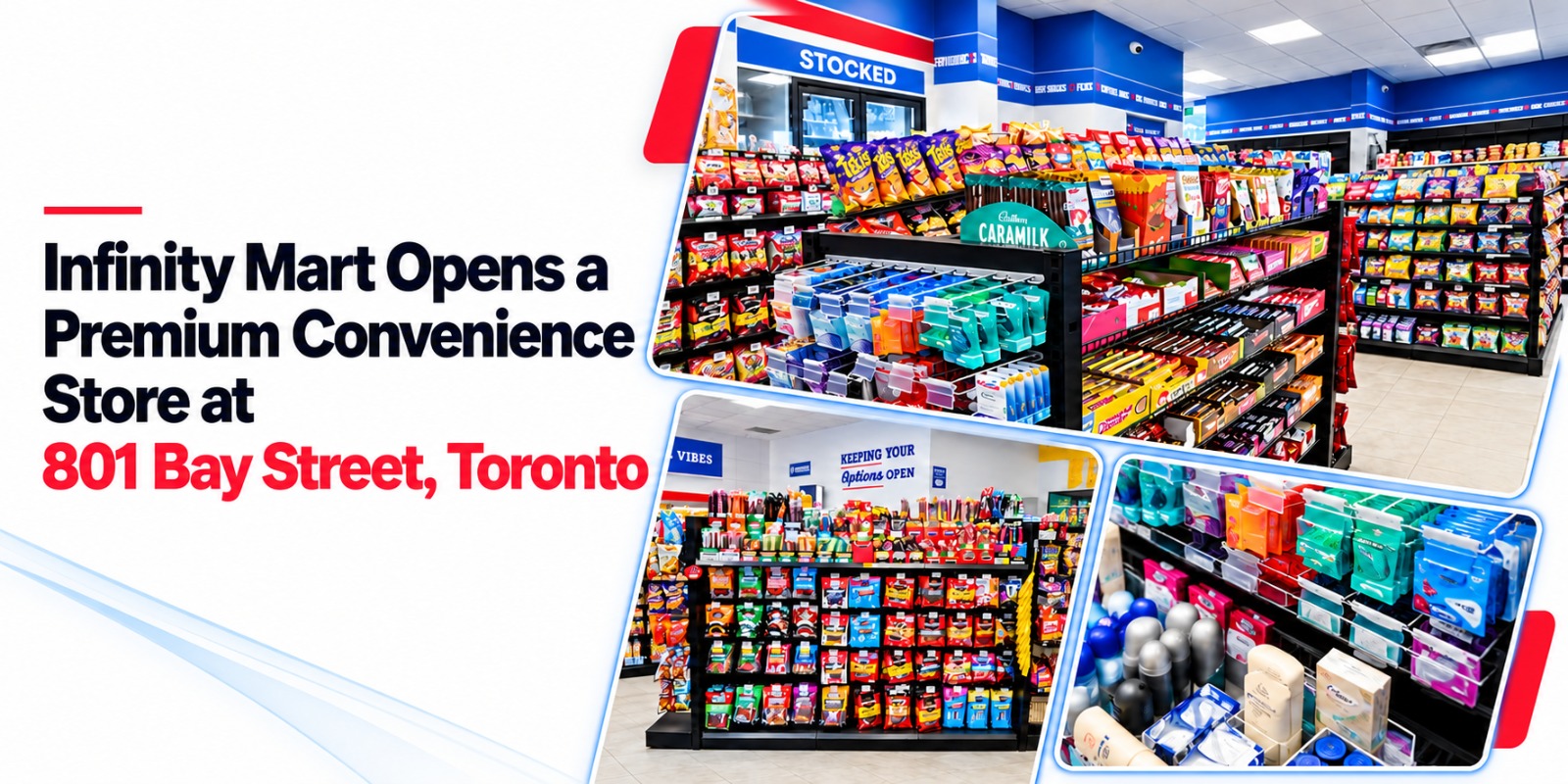
Infinity Mart Opens Premium Convenience Store at Bay Street
September 29, 2026
How Much Money Do You Need to Open a Convenience Store?
September 26, 2026
Infinity Mart Opens New Convenience Store on Portage Ave, Winnipeg
September 8, 2026
Infinity Mart Opens New Convenience Store Near Fort York, Toronto
September 2, 2026