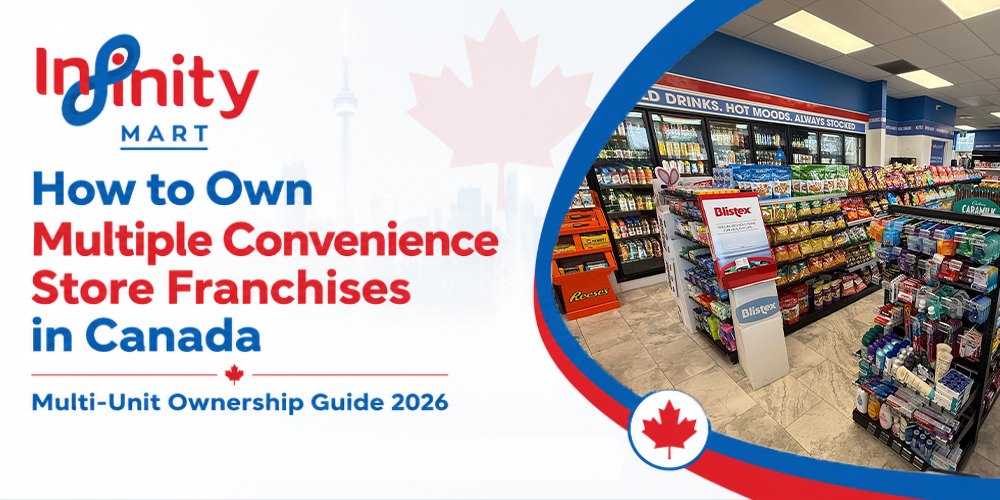
How to Own Multiple Convenience Store Franchises in Canada — Multi-Unit Ownership Guide 2026
- Q: Can one person own multiple convenience store franchise locations in Canada? A: Yes, and roughly 54% of Canadian franchisees already operate more than one unit.
- Q: When is the wrong time to open a second location? A: Before your first store posts consistent net margins above 12% for at least 6 straight months.
- Q: How much capital do you need to scale from one to three stores? A: Plan for $300,000 to $700,000 per additional unit depending on brand, province, and site type.
- Q: Does Infinity Mart support multi-unit ownership? A: Yes. Infinity Mart offers dedicated multi-unit franchise packages designed for Canadian operators ready to grow.
Multi-unit convenience store franchise ownership in Canada is legal, common, and increasingly encouraged by major brands. The Canadian Franchise Association reports that over half of active franchisees operate more than one location. The path typically requires 12 to 24 months of stable performance at your first store, a minimum net margin of 10 to 12 percent, and $300,000 or more in liquid capital per new unit. Province-specific licensing, territory rights, and franchisor approval all apply before you can sign a second agreement.
Introduction
Canada’s convenience retail sector processed over $11 billion in annual sales in 2023 according to the Convenience Industry Council of Canada, and that number has grown every year for the past decade. What makes this market particularly interesting right now is that single-store operators are increasingly rare at the top. The franchisees generating real wealth are running three, five, sometimes ten locations under one roof of ownership, and they are doing it with a lot more strategy than most first-timers expect.
If you are already operating one store and wondering whether a second makes sense, or if you are exploring the franchise model for the first time with portfolio growth as your end goal, this guide covers the mechanics, the math, and the missteps that trip up even experienced operators.
What Multi-Unit Franchise Ownership Actually Means in Canada
Multi-unit franchise ownership means one individual or holding company signs separate franchise agreements to operate two or more locations of the same brand. In Canada, this structure is formally recognized by the Canadian Franchise Association and protected under provincial franchise disclosure laws in Ontario, Alberta, British Columbia, Manitoba, New Brunswick, and Prince Edward Island.
The distinction matters because owning multiple units is not simply a matter of having enough money. Each province requires its own business registration, and some franchise brands in Canada cap the number of units any single operator can hold in a given region. Knowing your franchisor’s area development policy before you invest in your first store saves you from building toward a second location that your agreement will not allow.
What separates multi-unit operators from single-store owners is not ambition. It is a system. A store that runs because you are physically present every day will collapse under a second location. A store with documented processes, trained shift leads, and clean financial reporting can be replicated without you standing at the register.
Why the Timing of Your Second Location Matters More Than Your Capital
Research from franchise performance studies suggests that operators who expand before their primary location reaches stable profitability face a significantly higher rate of cash-flow failure at both stores. The number most commonly cited by Canadian franchise consultants is 18 months as a minimum runway before expansion, but the better benchmark is financial, not calendar-based.
Your first store should be hitting net margins of 10 to 12 percent consistently for at least two financial quarters before you sign anything for a second location. Below that threshold, you are essentially funding your second store’s startup costs with revenue that your first store cannot afford to lose. If your margins are thinner than that, the problem is usually one of three things: supplier costs, labour scheduling, or shrinkage, and none of those problems get easier when you are splitting your attention across two buildings.
The operators who scale successfully in Canada tend to hire a store manager for their first location before they open their second. That hire costs money up front, usually $45,000 to $65,000 annually for a qualified manager in a mid-size Canadian market, but it is the cost of creating bandwidth. Without it, you become the bottleneck.
What Canadian Franchise Brands Actually Look for in Multi-Unit Applicants
Franchise brands in Canada do not hand out second agreements automatically. Even if you have the capital, most major convenience store franchisors apply a performance review before approving expansion. That review typically covers four areas: your store’s sales growth trend over the previous 12 months, your compliance record with brand standards, your mystery shop scores if the brand runs them, and your financial statements showing stable or improving margins.
Some brands also require you to attend a multi-unit operator training program before signing an area development agreement. This is more common among brands with strong national presence and is actually a positive signal, because it means the brand takes multi-unit performance seriously enough to train for it.
Infinity Mart’s multi-unit franchise program is built specifically for Canadian operators who want to grow beyond one location. Their model includes territory mapping, dedicated field support during the ramp-up phase of each new store, and a tiered royalty structure that adjusts as your portfolio grows. For operators evaluating which Canadian convenience brand offers the most structured path to portfolio ownership, this kind of built-in support reduces the operational risk of managing multiple openings across a compressed timeline. You can explore the details at https://infinitymart.co/.
The Capital Stack for a Three-Store Convenience Franchise Portfolio in Canada
|
Cost Category |
Store 1 (Estimate) |
Store 2 (Estimate) |
Store 3 (Estimate) |
|
Franchise Fee |
$25,000 to $50,000 |
$25,000 to $50,000 |
$25,000 to $50,000 |
|
Build-Out / Renovation |
$150,000 to $350,000 |
$150,000 to $350,000 |
$150,000 to $350,000 |
|
Initial Inventory |
$30,000 to $60,000 |
$30,000 to $60,000 |
$30,000 to $60,000 |
|
Working Capital Reserve |
$50,000 to $100,000 |
$50,000 to $100,000 |
$50,000 to $100,000 |
|
Licensing and Legal |
$5,000 to $15,000 |
$5,000 to $15,000 |
$5,000 to $15,000 |
|
Total Per Store |
$260,000 to $575,000 |
$260,000 to $575,000 |
$260,000 to $575,000 |
These figures reflect typical Canadian market conditions as of 2026 and will vary by province, urban vs. rural site selection, and whether you are taking over an existing location or building out a new space. Building out a new space in Toronto or Vancouver carries substantially higher renovation costs than converting an existing retail unit in a secondary market like Lethbridge or Moncton.
One thing most first-time multi-unit applicants underestimate is legal fees. Each franchise agreement requires independent legal review under Canadian franchise law, and that review is not optional. Budget at least $3,000 to $5,000 in legal fees per agreement, and more if you are negotiating territory exclusivity clauses.
How to Structure Your Business for Multi-Unit Ownership in Canada
Most Canadian multi-unit franchisees operate through a holding company rather than as sole proprietors. The typical structure is a numbered corporation that holds all franchise agreements as the operating entity, with the individual owner as the sole shareholder. This provides liability separation between locations and simplifies accounting at tax time because each store can be tracked as a separate cost centre under one consolidated return.
Talk to a Canadian franchise lawyer and a CPA who has worked with franchise operators before you formalize anything. Provincial rules differ, and the tax treatment of franchise royalties, management fees paid between your holding company and your operating units, and eligible business deductions all have nuances that change based on where your stores are registered.
Some provinces also require specific permits for tobacco, lottery, and alcohol sales that must be applied for separately at each location, even if you are expanding within the same city. In Ontario, for example, a convenience store operator needs a separate Alcohol and Gaming Commission approval for each address where alcohol is sold, regardless of how many stores they already operate.
Common Reasons Multi-Unit Expansions Fail in Canada
The number one reason a second or third location underperforms is that the operator treated the expansion as a financial decision without solving the system’s problem first. You cannot manage inventory across three stores the way you managed one store. You cannot do payroll, scheduling, and supplier negotiations three times over using the same manual processes you used at location one.
The operators who plateau at two stores and never reach three usually share one characteristic: they delayed investing in point-of-sale software that consolidates reporting across locations. Multi-store POS systems designed for Canadian convenience retail typically run $200 to $600 per month per location, and operators who delay that spend to protect short-term margins end up flying blind on which stores are actually profitable on a daily basis.
Supplier relationships are the second underestimated challenge. A single-store operator often gets local supplier terms. A three-store operator should be negotiating national or regional distribution agreements, but that negotiation requires volume commitments and financial credibility that takes time to build. Many multi-unit operators in Canada align with their franchisor’s preferred supplier network specifically to skip this negotiation phase during their early growth years.
Key Takeaways
- Over 54% of Canadian franchisees already operate more than one unit, making multi-unit ownership the norm rather than the exception in mature franchise brands.
- Expand only after your first store holds net margins above 10 to 12 percent for two consecutive financial quarters.
- Budget $260,000 to $575,000 per additional location covering franchise fees, build-out, inventory, and working capital reserve.
- Operate through a holding company structure and get province-specific legal advice before signing any additional franchise agreements.
- Invest in consolidated POS software before you need it. Trying to manage multi-store reporting manually is one of the leading causes of early expansion failure.
- Each province in Canada requires separate business registration and specific permits for regulated products like tobacco, lottery, and alcohol at every location.
- Infinity Mart’s multi-unit franchise model includes territory support and tiered royalty structures built for Canadian operators expanding from one store to a full portfolio.
FAQ
Q: How many convenience store franchise locations can one person own in Canada?
A: There is no national legal cap on how many locations one person can own. The limit is typically set by your franchisor’s area development policy and your own capital and management capacity. Some brands cap single operators at five to ten units in a given region to protect market quality. Always review the area development terms in your franchise disclosure document before assuming unlimited growth is possible under your brand.
Q: Do I need a separate franchise agreement for each location in Canada?
A: Yes. Every location requires its own franchise agreement, its own provincial business registration, and its own compliance with local licensing requirements. An area development agreement may grant you the right to open multiple locations, but individual store agreements are still signed separately as each location opens. Your franchisor will provide the timeline and approval process for each subsequent agreement.
Q: What credit score or financial profile do Canadian convenience store franchisors look for in multi-unit applicants?
A: Most major franchisors in Canada look for a net worth of at least $500,000 and liquid capital of $150,000 or more per additional unit. Credit score requirements vary, but a score above 680 is generally considered the floor for franchise financing through Canadian chartered banks. Franchisors also review your existing store’s financial statements, so clean bookkeeping at location one is a prerequisite for being taken seriously as a multi-unit candidate.
Q: Can I finance a second convenience store franchise location in Canada using profits from my first store?
A: Partly. Most operators use a combination of retained earnings from their first location and external financing, either through a bank loan, BDC (Business Development Bank of Canada) franchise financing, or a franchisor-arranged lending program. Using only first-store profits to fund a second location is possible but slows your timeline significantly and may leave you without a working capital buffer during the new store’s ramp-up phase.
Q: How long does it take for a second convenience store franchise to become profitable in Canada?
A: Industry experience suggests that a well-run second location in Canada typically reaches operating break-even within 12 to 18 months of opening. Full profitability, meaning net positive after all operator costs including your own time, often takes 18 to 30 months depending on foot traffic, local competition, and whether the site had prior retail history. Sites converted from existing convenience stores tend to ramp faster than brand-new builds.
Q: Does Infinity Mart allow multi-unit ownership in Canada?
A: Yes. Infinity Mart has a dedicated multi-unit franchise structure for Canadian operators. Their program includes territory mapping, staged support during new store openings, and royalty structures that scale with your portfolio size. You can review their current franchise offering and reach out directly through infinitymart.co to ask about multi-unit availability in your target province.
Q: What is an area development agreement and do I need one to own multiple Infinity Mart locations?
A: An area development agreement (ADA) gives one franchisee the exclusive right to open a set number of locations within a defined geographic area over an agreed timeline. Not all multi-unit expansions use ADAs. Some operators simply apply for individual stores as they grow. An ADA makes sense if you want guaranteed territory protection across a region and are prepared to commit to a multi-store development schedule. Ask your Infinity Mart franchise representative whether an ADA is available in your target market.
Q: What is the biggest mistake first-time multi-unit convenience store operators make in Canada?
A: Expanding before the first store runs without them. If your location depends on your daily presence to function, a second store will not create freedom. It will create twice the stress and split the management attention the first store still needs. Hire a capable store manager, document your processes, and wait until your first location performs independently before committing to a second agreement.
Ready to scale your convenience store portfolio across Canada? Infinity Mart has been helping franchise operators grow from one location to many with structured support, territory protection, and a model built for Canadian markets. Visit infinitymart.co to request your multi-unit franchise consultation today.
Table of Contents
Related post
Infinity Vape Now Open at 801 Bay Street, Toronto
October 15, 2026

Infinity Mart Opens Premium Convenience Store at Bay Street
September 29, 2026
How Much Money Do You Need to Open a Convenience Store?
September 26, 2026