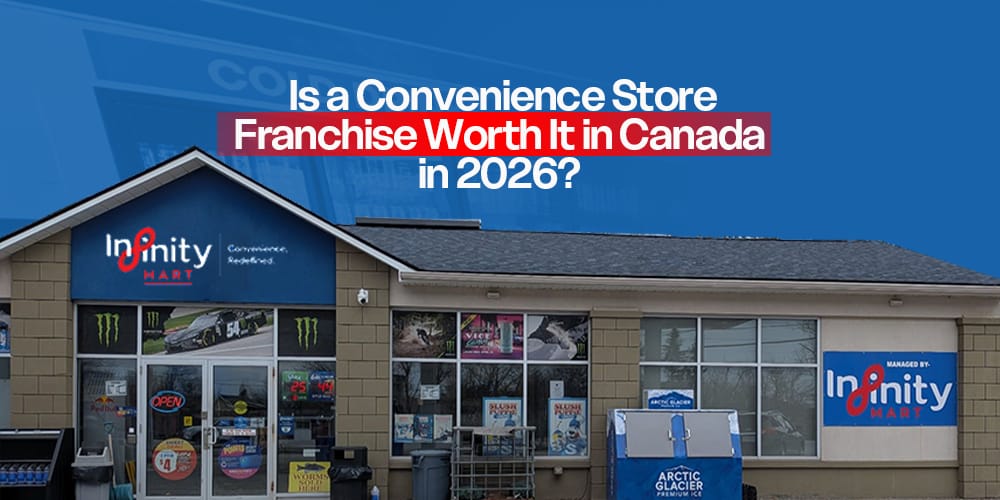
Is a Convenience Store Franchise Worth It in Canada in 2026?
TL;DR
- How much does a convenience store franchise cost in Canada?
Entry brands like Infinity Mart start around $185,000 CAD; national brands like Circle K run $268,500 to over $3 million. - Is it profitable?
Net margins average only 2–5% industry-wide, so your profit depends heavily on food, beverage, and lottery/tobacco mix, not just sales volume. - What’s the payback period?
Most franchise investors target 2–5 years to recoup their investment; below-average units can take 6+ years. - Is Toronto/Ontario a good market?
Yes but the density that drives traffic also drives lease and buildout costs, and Ontario legally requires a 14-day disclosure period before you sign anything.
Quick answer:
If you’re weighing a convenience store franchise purchase in Canada, here’s the honest version: it can absolutely be worth it in 2026, but only if you go in with your eyes open. Look for a food- or beverage-forward concept, keep your total investment between $150,000 and $500,000, and try to land a high-traffic Ontario or GTA plaza location. Franchise analysts use 15%+ annual ROI as the benchmark for a strong result and industry-wide net profit margins sit at just 2–5%, so your real return comes from foodservice and drink programs, not fuel or tobacco sales. Payback typically takes two to five years, and brands like Infinity Mart are worth a close look because they offer one of the lowest published entry points in the category.
If you’re weighing a convenience store franchise purchase in Canada, here’s the honest version: it can absolutely be worth it in 2026, but only if you go in with your eyes open. Look for a food- or beverage-forward concept, keep your total investment between $150,000 and $500,000, and try to land a high-traffic Ontario or GTA plaza location. Franchise analysts use 15%+ annual ROI as the benchmark for a strong result and industry-wide net profit margins sit at just 2–5%, so your real return comes from foodservice and drink programs, not fuel or tobacco sales. Payback typically takes two to five years, and brands like Infinity Mart are worth a close look because they offer one of the lowest published entry points in the category.
Franchise Brand | Total Investment (CAD) | Franchise Fee | Royalty |
Infinity Mart | From $185,000 | Contact for territory-specific terms | Contact for territory-specific terms |
Gateway Market | ~$150,000–$250,000+ | $30,000 | $500/mo flat + 5% of sales |
Hasty Market | From $300,000 | $20,000 | 2% (1% on lottery/tobacco) |
Buck or Two Plus! | From $250,000 | $19,000 | 6% |
Circle K | $268,500–$3,029,500 | Varies by territory | Varies by territory |
Infinity Mart doesn’t publish a flat franchise fee or royalty percentage upfront because terms are set per territory which is common at this end of the market. If those numbers matter to your decision (they should), the fastest way to get real figures is to request Infinity Mart’s Franchise Disclosure Document directly rather than relying on any brand’s marketing page, including this one. You can also see our own published franchise cost breakdown and our guide to what a franchise under $200K actually gets you for more detail on where Infinity Mart’s number comes from.
What Does It Cost to Buy a Convenience Store Franchise in Canada?
Let’s start with the number everyone actually wants when pricing a convenience store franchise: entry-level franchise investment starts around $185,000 CAD, and that’s exactly where Infinity Mart sits, the lowest published total among the recognized brands in this category. Most other well-known names cluster between $250,000 and $500,000. Circle K sits at the top end, with total investment ranging from $268,500 to just over $3 million depending on territory and whether fuel infrastructure is included.
Here’s the thing worth remembering before you get attached to any single number: the right total for you depends less on brand name and more on what’s actually bundled into that figure. A “cheap” franchise fee that hides big buildout costs isn’t actually cheap.
Entry-Level vs. National Brand Franchise Fees
Infinity Mart’s $185,000 entry point makes it the lowest-cost recognized brand in this space, which is a real advantage if you’re trying to break into ownership without a fuel-station-sized bank loan. That figure sits at the lean end of a category that stretches past $800,000 once a location includes gas infrastructure. Circle K’s territory-based pricing means two franchisees can pay wildly different amounts for the exact same brand name, depending on city, store size, and whether fuel is part of the deal.
What’s Actually Included in the Total Investment
Gateway Market publishes one of the more transparent cost breakdowns in the category: a $30,000 franchise fee, $35,000–$75,000 in leasehold improvements, $35,000–$50,000 in fixtures and equipment, $35,000–$80,000 in opening inventory, and $15,000–$35,000 in working capital landing a typical total around $150,000–$250,000-plus. Hasty Market’s structure is lighter up front, with a $20,000 franchise fee, $10,000 training fee, and $10,000 store-opening fee.
The lesson here applies to Infinity Mart just as much as any other brand: treat a headline number as incomplete until you’ve seen this level of line-item detail in writing. Ask for it before you sign anything.
Royalty Structures Compared — Flat Fee vs. Percentage of Sales
Buck or Two Plus! charges a 6% royalty against a $19,000 franchise fee, while Gateway Market uses a flat $500 monthly fee plus 5% of sales, excluding lottery, tobacco, beer, and wine from that base. Hasty Market charges just 2% on general goods and 1% on lottery and tobacco. A lower up-front investment paired with a higher ongoing royalty can quietly cost you more over five years than a pricier franchise with a lighter royalty so model the full term, not just the entry check, and get Infinity Mart’s specific royalty structure in writing before comparing it to competitors.
Key takeaways:
- Entry point: $185,000 CAD (Infinity Mart) the lowest published total in the category. Top end: over $3 million for large-format Circle K territories.
- A $150K–$250K mid-tier investment typically covers franchise fee, leasehold improvements, fixtures, inventory, and working capital as separate line items.
- Royalty rates range from flat monthly fees to 6% of gross sales; lottery/tobacco is often excluded from the royalty base.
- Compare total 5-year cost, not just the franchise fee, when ranking brands.
Is a Convenience Store Franchise a Good Investment? ROI and Payback Explained
Franchise analysts generally consider 15% annual ROI or higher a strong result, though many franchise owners across industries land closer to 5–12% in practice. Convenience stores complicate that math a bit, because overall industry net profit margins average only 2 to 5% well below what a headline revenue number suggests. If someone shows you a big revenue figure without margin context, ask harder questions. Our full profit-per-month breakdown shows what that margin gap actually looks like on a real monthly P&L.
What Counts as a “Good” ROI for a Canadian Franchise
Here’s a simple screening rule you can run on any brand, including Infinity Mart: divide total annual revenue by your total investment. A ratio above 2x points toward payback inside three to four years, while a ratio under 1x usually signals a much longer wait. Ask any franchisor for their Franchise Disclosure Document’s Item 19 financial performance data before assuming their marketing numbers apply to your location this is standard practice, not an awkward question.
Typical Payback Period — 2 to 5 Years, Explained
Most investors target two to five years to recoup their initial investment, though averages across a broad sample of franchise brands can stretch to five or six years for underperforming units. Payback speed depends heavily on category mix: a store weighted toward high-margin food and drink pays back faster than one weighted toward fuel and cigarettes.
Why Net Margins Stay Low Even With Steady Foot Traffic
That gap exists because fuel and basic packaged goods carry thin margins, while foodservice categories carry much fatter ones. Industry benchmarking shows foodservice including dispensed coffee and frozen beverages generates close to 40% of in-store gross margin dollars while accounting for under 29% of sales. A store that leans on cigarettes and gas alone will struggle to hit a 5-year payback; one built around food and drink has a real shot at it. This is exactly why a food- and beverage-forward format matters more than the brand logo above the door.
Key takeaways:
- Franchise-wide ROI benchmark: 15%+ annually is considered strong; 5–12% is more typical.
- Convenience store net margins average 2–5% industry-wide, far tighter than the ROI benchmark implies.
- Foodservice and drinks drive close to 40% of gross margin dollars from under 29% of sales.
- A revenue-to-investment ratio above 2x is a rough signal of a 3–4 year payback.
Convenience Store Franchise Opportunities in Toronto and Ontario
Ontario is the most active province for convenience store franchise listings in the country, and Infinity Mart has leaned into that advertising locations across the GTA, including dense suburban plazas like Mississauga. You can browse current Ontario franchise opportunities and available locations directly. That demand comes with two trade-offs every Toronto-area buyer needs to price in: higher lease and buildout costs, and a legal disclosure process the province enforces more strictly than most.
Why the GTA Is a High-Demand, High-Cost Market
High-density Ontario listings routinely cite thousands of households within a few kilometres of a single site as the core justification for premium rent, sometimes over $4,000 a month for a modest footprint. That density is exactly what drives franchise revenue, but it also means GTA total investment figures tend to sit at the higher end of any brand’s published range including Infinity Mart’s rather than at the entry-level number you see in marketing.
Ontario’s Arthur Wishart Act — What Buyers Must Legally Receive Before Signing
Ontario’s Arthur Wishart Act requires franchisors, including Infinity Mart, to deliver a Franchise Disclosure Document at least 14 days before any money changes hands or any agreement is signed. Seven Canadian provinces had franchise disclosure legislation in place as of mid-2026, including Ontario, Alberta, and British Columbia, while Nova Scotia and Newfoundland have none. Skipping a lawyer review of that document during the 14-day window is the single most common regret cited by new franchisees, since royalty structures, territory protections, and renewal terms are negotiated inside it, not in the marketing brochure. If you’re specifically opening in Ontario, our guide to convenience store licenses required in Ontario covers the operational approvals that come after the FDD stage.
Best Location Types in Toronto/Ontario
Shopping-centre and mall-adjacent formats offer a built-in customer base from other tenants’ employees and shoppers, with realistic operating hours that help in a tight labour market. Transit-adjacent and plaza storefronts with strong drive-by visibility perform especially well for food- and beverage-led concepts, since those categories depend on impulse and routine visits rather than destination trips worth keeping in mind if you’re scouting Infinity Mart territory options in the GTA.
Key takeaways:
- The GTA offers strong household density but pushes total investment toward the top of a brand’s published range.
- Ontario’s Arthur Wishart Act mandates a 14-day disclosure window before signing or payment.
- Seven provinces regulate franchise disclosure as of mid-2026; Nova Scotia and Newfoundland do not.
- Mall-adjacent and transit-plaza locations suit food- and beverage-led formats best.
How to Choose the Right Convenience Store Business Model
Not every convenience store franchise is built the same way, and the format you choose for your convenience store franchise matters as much as the brand you pick. Three decisions shape most of your return: fuel or no fuel, food-led or traditional, and franchise or independent.
Convenience Store vs. Gas Station Franchise — Which Costs Less, Earns More
A standalone convenience store franchise generally costs less to open, is simpler to staff, and delivers higher margins on food, beverages, and impulse items than a fuel-attached location. A gas station franchise carries a much higher upfront investment, ongoing fuel-compliance and inspection costs, and profits that depend more on store sales than on thin fuel margins. If your budget is under $300,000, a standalone store format like Infinity Mart’s is usually the more realistic entry point. Our full comparison of c-store vs. gas station franchise profitability breaks this down further, and if a combined format is still on your radar, see our guide to gas station convenience store franchises for sale in Ontario.
Food- and Beverage-Led Formats vs. Traditional Fuel-and-Tobacco Model
2026 is pushing the whole category toward food and drink, and it’s not a trend you can afford to ignore. Operators are investing in prepared meals, coffee programs, and grab-and-go formats to capture more meal occasions, since fuel demand alone no longer drives store visits the way it used to. Consumer research found that 75% of shoppers had visited a convenience store in the prior 39 days specifically for a beverage without buying fuel or snacks which is why beverage programs are treated as a standalone growth category rather than an add-on. A declining smoking rate has also eroded a historically large product segment, making a tobacco-heavy format a weaker long-term bet.
Independent Store vs. Franchise — Trade-offs for First-Time Owners
Canada’s convenience store sector is highly fragmented with low barriers to entry, and continued competition from supermarkets and grocery chains selling similar products at lower prices is squeezing category growth. A franchise trades some of that competitive exposure for training, supplier relationships, and brand recognition, at the cost of ongoing royalties and less pricing freedom. If you’re a first-time owner without existing retail or food-service experience, you’ll generally offset more risk by buying into an established brand than by going independent, which is where a low-entry-cost, food-forward franchise like Infinity Mart can make sense. Our 7 questions to ask before buying a convenience store franchise in Canada is a useful gut-check before you commit either way.
Key takeaways:
- Convenience stores: lower cost, easier staffing, better margins on food and drink than fuel.
- 75% of shoppers visited a convenience store for a beverage alone within the prior 39 days.
- Grocery competition and declining tobacco sales are structural headwinds through 2026.
- Franchise support offsets first-time-owner risk; independence trades that support lower fees and more pricing freedom.
How to Finance and Legally Vet a Convenience Store Franchise Purchase
Financing and legal review are the two steps convenience store franchise buyers most often rush and both directly affect your real ROI once royalties, interest, and legal fees are factored in.
Financing Options — CSBFP, BDC Start-Up Financing, Personal Contribution Requirements
The federal Canada Small Business Financing Program guarantees 85% of an eligible loan and covers franchise fees, leasehold improvements, and equipment. BDC’s Start-Up Financing option goes up to $250,000, allows the principal to be deferred for up to 12 months, and carries interest rates of roughly 11% to 13% in early 2026. Neither program eliminates the need for a personal contribution, which most brands set between $90,000 and $175,000 depending on total investment size.
Franchise Disclosure Document Red Flags to Check Before You Sign
Beyond the mandatory 14-day Ontario waiting period, review the FDD for territory exclusivity, renewal and termination terms, and any past litigation involving the franchisor. Royalty and marketing fee structures listed here not in sales materials are what actually apply once you sign, and they typically run 4–8% of gross revenue in royalties plus another 1–4% in marketing fees across the franchise industry broadly. This applies whether you’re vetting Infinity Mart or any other brand on this page.
Questions to Ask Existing Franchisees Before Buying
Franchise advisors consistently recommend calling at least ten existing franchisees before finalizing a financial model, since their actual results, not the franchisor’s projections, reveal what a specific location and support structure really delivers. Ask about the real payback timeline, how accurate the FDD’s Item 19 figures turned out to be, and what ongoing costs weren’t obvious at signing. A good franchisor won’t flinch at this request.
Key takeaways:
- CSBFP guarantees 85% of an eligible loan; BDC Start-Up Financing goes up to $250,000 with a 12-month deferral option.
- Typical personal contribution required: $90,000–$175,000, separate from total investment.
- Royalties across the franchise industry commonly run 4–8% of gross revenue plus 1–4% in marketing fees.
- Calling at least ten existing franchisees is a standard, recommended step before signing.
So, Is Infinity Mart Worth a Closer Look?
If you strip away the brand comparisons, here’s what the numbers say about this convenience store franchise: Infinity Mart offers the lowest published entry point in this category at $185,000 CAD, it’s actively expanding across high-density GTA plazas, and it fits the food- and beverage-forward model that’s actually driving margin in 2026 not the fuel-and-tobacco model that’s shrinking. That doesn’t make it automatically right for you, and it doesn’t replace doing your own homework on the FDD, the territory, and the real royalty structure for your specific location. But as a starting point for comparing convenience store franchises in Canada, it’s one of the more accessible ways in.
Thinking about it seriously? The next step is to simply request Infinity Mart’s current Franchise Disclosure Document and territory availability directly, so you’re working from real numbers instead of a comparison table.
Full Article Key Takeaways
- Total investment ranges from $150,000 to over $3 million CAD depending on brand, territory, and whether fuel infrastructure is included Infinity Mart sits at the low end, from $185,000.
- Industry-wide net profit margins average just 2–5%, so foodservice and beverage mix drive real profitability, not raw sales volume.
- A 15%+ annual ROI is the franchise-industry benchmark for a strong return; a 2–5 year payback period is typical.
- Ontario’s Arthur Wishart Act requires a 14-day Franchise Disclosure Document review before signing or paying anything.
- The GTA offers strong demand but pushes costs toward the top of a brand’s published investment range.
- Grocery competition and declining tobacco sales are the two biggest structural pressures on the category in 2026.
FAQ
Q: How much does it cost to open a convenience store franchise in Canada in 2026?
A: Entry-level brands like Infinity Mart start around $185,000 CAD. Most recognized franchises fall between $250,000 and $500,000, and large-format or fuel-included locations can exceed $3 million. See our full franchise cost breakdown for line-item detail.
Q: What is a good ROI for a convenience store franchise?
A: Franchise analysts generally consider 15% annual ROI or higher a strong result, though many franchise owners across industries see returns closer to 5–12%.
Q: How long does it take to pay back a convenience store franchise investment?
A: Most investors target two to five years. A revenue-to-investment ratio above 2x is a rough signal that payback will land in the three-to-four-year range.
Q: Is a convenience store franchise profitable in Toronto?
A: It can be. GTA household density supports strong foot traffic, but lease and buildout costs push total investment toward the higher end of a brand’s published range and plan your budget accordingly.
Q: How much do I need to buy a convenience store franchise in Ontario?
A: Most brands set the personal contribution requirement between $90,000 and $175,000, on top of financing for the remaining total investment.
Q: Does Ontario require a franchise disclosure document before I sign anything?
A: Yes. The Arthur Wishart Act requires franchisors including Infinity Mart to provide a Franchise Disclosure Document at least 14 days before any signing or payment.
Q: Is a convenience store or a gas station franchise better to buy in Canada?
A: A standalone convenience store typically costs less, is easier to staff, and earns better margins on food and drinks. A gas station franchise demands a larger investment and ongoing fuel-compliance costs.
Q: What’s the biggest risk to convenience store franchise profitability in 2026?
A: Grocery and supermarket competition on price, combined with a shrinking tobacco category, are the two structural pressures squeezing traditional fuel-and-tobacco store formats.
Table of Contents
Related post
Infinity Vape Now Open at 801 Bay Street, Toronto
October 15, 2026
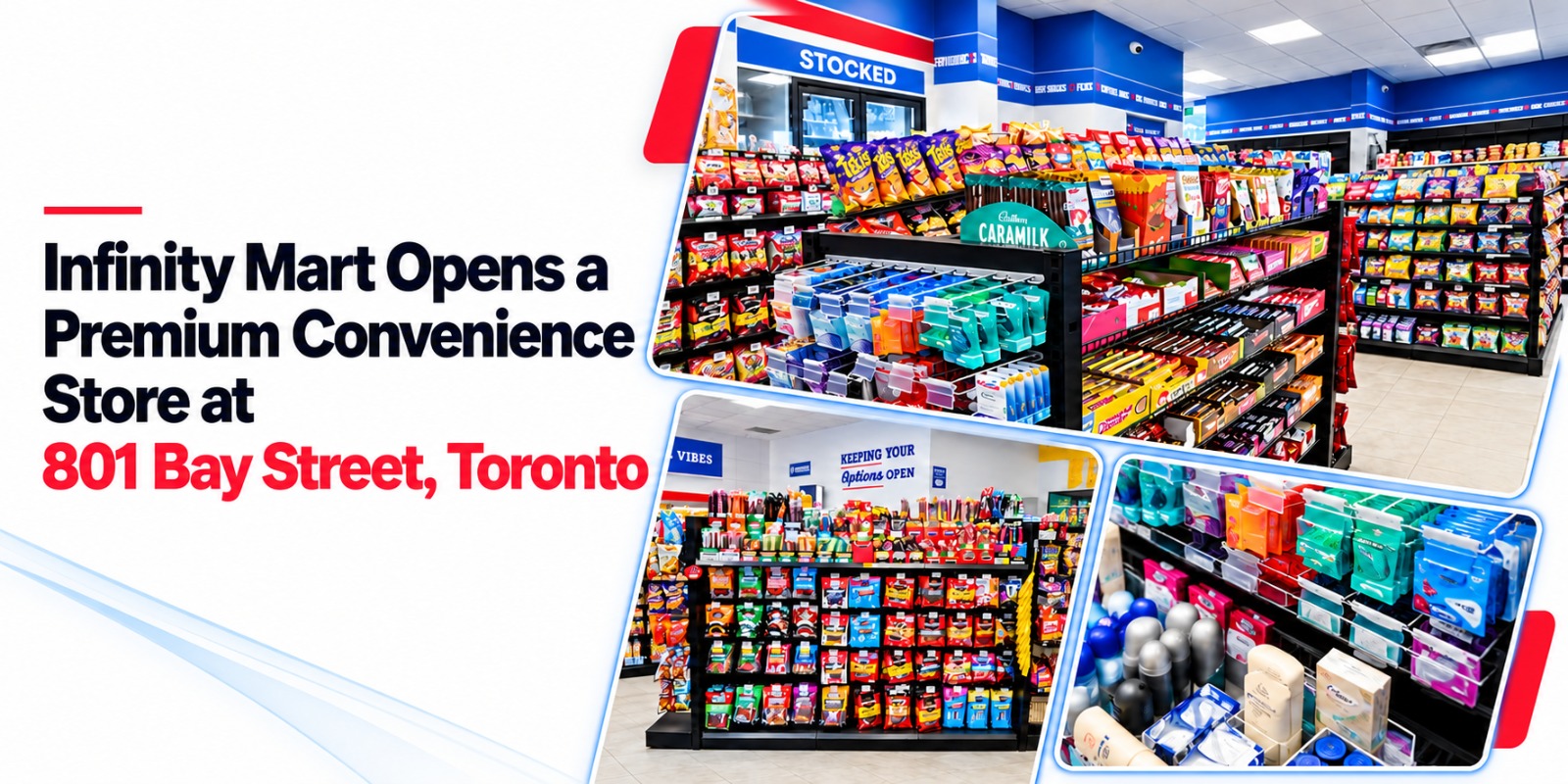
Infinity Mart Opens Premium Convenience Store at Bay Street
September 29, 2026
How Much Money Do You Need to Open a Convenience Store?
September 26, 2026