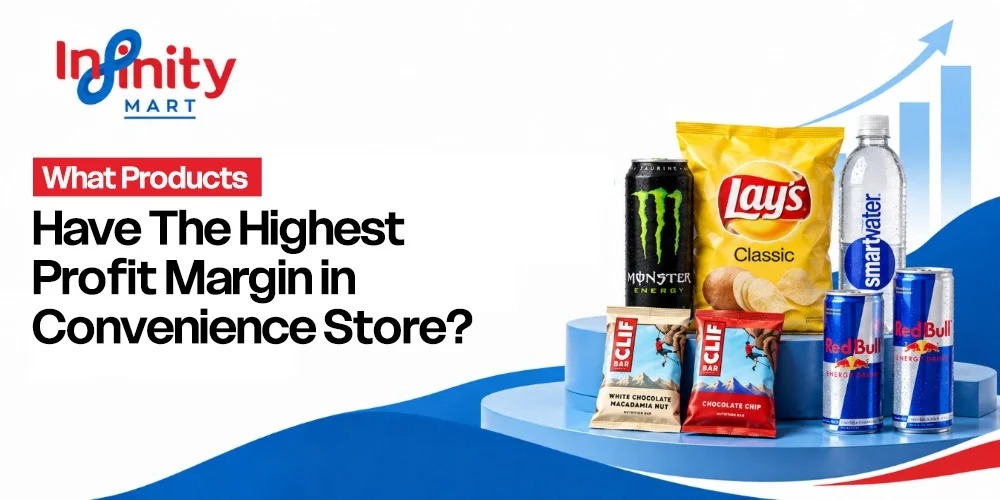
What Products Have the Highest Profit Margin in a Convenience Store?
Walk into any gas station and look at what people carry to the counter. A cup of coffee. A bag of chips. A cold drink.
Now look at what brought them there: fuel, cigarettes, a lottery ticket. Those bring people in, but they rarely make the store rich.
Here’s the short answer. Fountain drinks are among the highest-margin items in the entire store, often exceeding 80%. Coffee, prepared food, candy and health and beauty items follow close behind.
This guide breaks down the numbers, explains why some items earn so much more than others, and shows what it means for the profit margin in a convenience store.
What Does “Profit Margin in a Convenience Store” Actually Mean?
Profit margin is the share of each sale you keep as profit. There are two kinds, and mixing them up is the most common mistake.
- Gross margin: what’s left after you subtract the cost of the product.
- Net margin: what’s left after rent, wages, card fees, utilities and everything else.
Here’s a quick example:
- A fountain drink sells for $2.00.
- The cup, ice and syrup cost about $0.40.
- Gross profit is $1.60, so the gross margin is 80%.
That 80% sounds huge. But the store still pays for the building, the staff and the electricity, so the final number is much smaller.
One more thing to remember: a high percentage on a cheap item isn’t the same as high profit in dollars. Volume matters too.
What Is the Average Convenience Store Profit Margin?
The average convenience store profit margin is thin. A typical net margin sits around 5–10%. Larger chains may get closer to 10%, while gross margins usually run between 25% and 45% depending on the product mix.
That gap between gross and net is why owners obsess over what’s on the shelf.
- Net margin: roughly 5–10%
- Gross margin: roughly 25–45%
- What closes the gap: rent, labor, shrinkage (theft and spoilage) and card fees
Small margins leave little room for error. A store that sells the right mix can do well. A store that sells the wrong mix works hard and barely breaks even.
Wondering what these margins mean in real dollars? See how much profit a convenience store owner actually makes per month.
The Most Profitable Convenience Store Items, Ranked
These are the most profitable convenience store items, starting with the strongest earners. Figures vary by source and region, so treat them as ranges, not promises.
Category | Typical gross margin | Why it earns |
Fountain drinks | 80%+ | Cheap ingredients, high price |
Coffee and hot drinks | Very high | Low cost, daily habit |
Prepared food | 35–60% | Made in-store, fast turnover |
Candy | 50%+ | Impulse buy at checkout |
Health and beauty | 50%+ | Small items, big markup |
Salty snacks | About 40% | Steady demand |
Packaged drinks | 30–45% | Huge volume |
Private label | 40–50% | You control the pricing |
1. Fountain Drinks and Slushies
This is usually the winner. The cup, ice and syrup cost cents, and customers happily pay a couple of dollars.
- Why it works: the ingredients are cheap and the product is made on the spot.
- Watch out for: underpricing. Many stores sell big cups too cheaply to attract customers.
2. Fresh Coffee and Hot Drinks
Coffee has the same math as fountain drinks, plus something extra: loyalty.
- People buy it daily, often at the same store.
- One store manager quoted by trade press called fountain drinks and coffee her two highest-margin products.
- Morning traffic near commuter routes can turn a coffee station into the busiest spot in the store.
3. Prepared and Grab-and-Go Food
Hot dogs, sandwiches, breakfast items and pizza slices all fall here. Margin estimates differ. One source puts prepared food at 35–40%, while another says 50–60%. The difference usually comes down to menu choices and food waste.
What isn’t in dispute is how much foodservice matters. In 2025 it made up 28.5% of inside sales but 38.9% of inside gross margin dollars.
- Keep the menu short and easy to make.
- Cook small batches to limit waste.
- Put hot food where people see it first.
4. Candy and Salty Snacks
Snacks are the classic impulse buy. Salty snacks carry a gross margin of nearly 40%, while candy delivers margins over 50%.
- Place them near the register and the pumps.
- Rotate stock so nothing sits past its date.
- Group them into “two for” deals to raise basket size.
5. Packaged Drinks: Energy, Soda and Water
The percentage is lower than fountain drinks, but the volume is huge. Packaged beverages made up 18.7% of inside sales in 2025.
Together, foodservice and packaged beverages accounted for 61.0% of inside profit dollars. Those two categories carry most of the store.
- Keep the cooler full, cold and easy to shop.
- Stock the brands your local customers actually ask for.
6. Health and Beauty Products
This is the surprise. Health and beauty items had the highest gross margin of any category at over 50%, though they sell in much lower volume.
- Toothpaste, sunscreen, razors and lip balm are the usual winners.
- Stock a small, smart selection. A shelf of slow-moving items ties up cash.
7. Private Label Products
Store-brand items give you more control over cost and price. Private label products can earn 40–50% margins compared to 25–35% for national brands. Treat that figure as a guide, not a guarantee.
Low-Margin Items Stores Still Sell (And Why)
Not everything on the shelf is there to make money. Some items exist to bring customers through the door.
- Cigarettes and tobacco: Tobacco carries a cost of about 85% of the selling price, leaving only around 15% gross margin. Taxes and regulations squeeze the rest.
- Lottery tickets: Stores profit about 5–6% on each ticket, plus a commission if they sell a winning one.
- Fuel: covered in the next section.
Think of these as traffic drivers. They pay for the customer’s visit. The high-margin items on the list above pay for the store.
Gas Station Convenience Store Profit Margin: Fuel vs. Inside Sales
Fuel confuses everyone. It looks like the main business, but it isn’t where most of the profit sits.
The gas station convenience store profit margin splits like this:
- Fuel accounted for 65% of sales at the average fueling store in 2025, but only 38.8% of gross profit dollars.
- Merchandise and foodservice made up 35% of sales and 57.4% of gross profit.
Fuel margins are counted in cents per gallon, not percentages. Large operators reported between 28 and 43 cents a gallon in 2025, before credit card fees.
Those fees matter. Fuel margins are volatile, and card swipe fees take a bite out of every gallon.
So where’s the real opportunity? Inside the store.
- Most pump customers never come inside.
- Converting even a small share of them into shoppers can change the whole year.
- A coffee station, fresh food and a clean, well-lit entrance all help.
This is also why the gas station combo format is popular with franchise investors. Infinity Mart pairs its stores with fuel brands like Esso, Mobil, Ultramar and Centex, so one site earns from both the pump and the shelf. You can read more on the Infinity Gas Station page.
How to Increase Profit Margin in a Convenience Store
You don’t need a big budget. You need a better mix and tighter habits.
- Give your best earners the best space. Put the coffee station, fountain machine and hot food where people walk first.
- Use the checkout. Candy and snacks belong at the register, where impulse buys happen.
- Keep the food menu short. Fewer items means less waste and faster service.
- Bundle smartly. A drink and a snack at a fixed price nudges people to spend more per visit.
- Track shrinkage weekly. Spoilage, theft and counting errors quietly eat profit. Catching them early is like a free price increase.
- Try a private label. Where a store-brand product performs well, it can lift overall margin.
Common Mistakes That Hurt Convenience Store Margins
Even good stores fall into these traps.
- Overstocking low-margin items just because they sell fast.
- Underpricing coffee and fountain drinks, which are already your best earners.
- Treating fuel as the profit plan instead of the traffic plan.
- Ignoring expiry dates on food and dairy.
- Guessing instead of measuring. Check your own supplier costs and sales data before copying someone else’s numbers.
How Infinity Mart Thinks About Product Mix
Infinity Mart is a Canadian convenience brand that runs standalone stores, gas station combos and vape-focused locations. Each format uses the same brand and operating standards.
A few things shape the product mix:
- Trusted supplier partners such as Coca-Cola, Red Bull, Frito-Lay and Monster support the beverage and snack shelves.
- Provincial programs like OLG and BCLC lottery, plus LCBO and The Beer Store partnerships, round out the range.
- Format matters. A combo location with fuel has different sales patterns than a standalone store.
Curious about the products or locations? Start with the Products or see available locations.
FAQs
What is the highest profit margin item in a convenience store?
Fountain drinks. Sources put their gross margin above 80% because the ingredients cost so little. Coffee, candy and health and beauty products also earn well.
What is the average convenience store profit margin?
Net profit margin usually falls around 5–10%. Gross margin is much higher, often 25–45%, before rent, wages and other costs come out.
Do gas stations make more money from fuel or from the store?
From the store. Fuel brings most of the sales, but inside sales bring more of the gross profit. Gas accounts for about 67% of revenue but only 39% of profit dollars.
Are cigarettes profitable for convenience stores?
Not very. Gross margin is low, around 15%, because of taxes and regulations. Stores carry them mainly because they bring steady customers.
What is a good profit margin for a convenience store owner?
A net margin near the top of the 5–10% range is solid. Reaching it usually means leaning on foodservice, beverages and well-placed snacks.
Which convenience store items should I stock first?
Start with a fountain drink and coffee station, then add grab-and-go food, packaged drinks and impulse snacks. Add health and beauty items in small quantities.
The Bottom Line
The profit margin in a convenience store comes from the small stuff: the coffee, the cold drink, the hot sandwich, the candy bar at the register.
Fuel and tobacco bring people in. Everything else keeps the lights on.
If you’re thinking about owning a store, or just curious how one earns its money, look at what’s near the counter. That’s usually where the profit is.
Not sure a franchise is the right move? See whether a convenience store franchise is worth it in Canada in 2026.
Want to own an Infinity Mart? Explore franchise opportunities to see the store formats, the application steps and the available locations.
Table of Contents
Related post
How Much Money Do You Need to Open a Convenience Store?
September 26, 2026
Infinity Mart Opens New Convenience Store on Portage Ave, Winnipeg
September 8, 2026
Infinity Mart Opens New Convenience Store Near Fort York, Toronto
September 2, 2026