
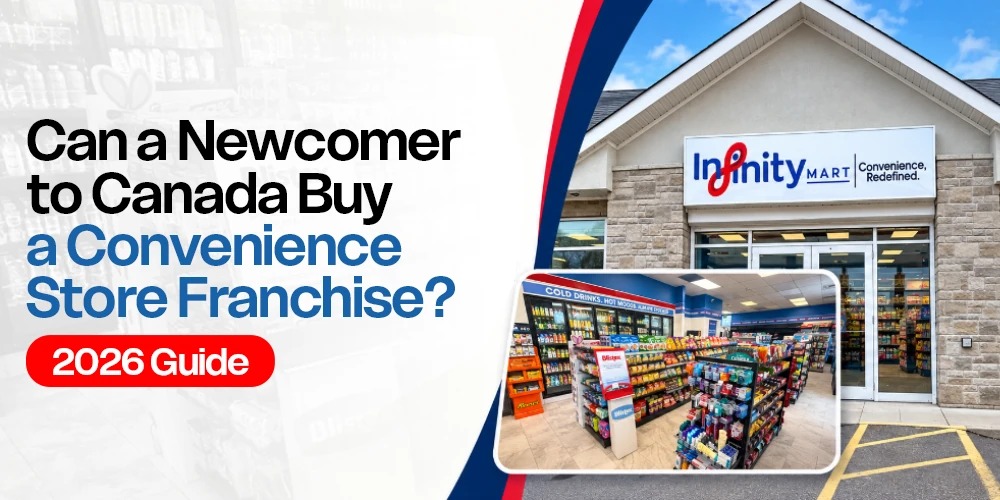
Can a Newcomer to Canada Buy a Convenience Store Franchise? (2026 Guide)
Yes. Newcomers to Canada, including permanent residents, can legally purchase and operate a convenience store franchise. Permanent residents require no additional permits. Work permit holders must verify their permit conditions. Total investment starts from $185,000 CAD. Canada’s franchise industry is projected to reach $133.3 billion in 2026, with convenience retail among its most stable sectors for first-time immigrant investors.
Who Can Legally Own a Convenience Store Franchise in Canada?
Can Permanent Residents Buy a Franchise in Canada?
Yes. Permanent residents hold the same business ownership rights as Canadian citizens. They can sign franchise agreements, hire staff, hold commercial leases, and operate a store without any additional immigration authorization. No extra permits are required to buy a convenience store franchise in Canada as a permanent resident.
Can Work Permit Holders Buy a Low Cost Franchise in Canada?
Work permit holders can own a franchise, but permit conditions must be carefully reviewed before proceeding. Most Canadian work permits authorize employment with a specific named employer in a defined role. Actively managing a business you own may fall outside those conditions. Consult a licensed immigration advisor before taking any steps. Non-compliance carries serious immigration consequences.
What Is the C11 Owner-Operator Work Permit?
The C11 permit allows foreign nationals to live and work in Canada by owning and managing a business that provides measurable economic benefit. To qualify, applicants must submit a detailed business plan, demonstrate sufficient investment capital, and show evidence of local job creation.
A convenience store franchise is well-suited to this pathway because it offers:
- Documented revenue potential from day one
- A proven operational model with franchisor support
- Clear employment records for staff
Many newcomer entrepreneurs have used the C11 permit to establish themselves in Canada through franchise ownership.
Can Temporary Residents or International Students Own a Franchise?
Temporary residents and international students face stricter legal restrictions around business ownership. In limited circumstances it may be possible, but specific legal authorization is required. Consult a licensed immigration lawyer before proceeding under these categories.
Why Convenience Store Franchises Work for Newcomer Investors
Recession-Resistant Demand
Convenience stores sell everyday essentials, beverages, snacks, tobacco, lottery tickets, and prepared food. Demand for these products remains stable even during economic downturns. When household budgets tighten, shoppers shift toward smaller and more frequent purchases, which increases convenience store traffic rather than reducing it.
Multiple Revenue Streams in One Location
A single convenience store location can generate income from:
- Retail product sales
- Lottery commissions through OLG (Ontario) or BCLC (British Columbia)
- Tobacco and alcohol sales where licensed
- Fuel partnerships at co-branded gas station sites
This spread of revenue categories reduces dependence on any one income source and supports more predictable cash flow year-round.
Lower Operational Complexity
Convenience store operations follow clear, repeatable daily processes. Transactions are short, product categories are familiar, and staffing requirements are manageable. For newcomers still building English or French fluency, this operational simplicity removes a significant barrier compared to service-intensive business types.
Built-In Franchise Support
Franchise ownership means you are not building systems from scratch. Training programs, inventory management, vendor relationships, and marketing frameworks are already established. For a newcomer unfamiliar with Canadian retail norms, this structure directly reduces early operational risk and shortens the learning curve significantly.
Real Investment Costs: What Does a Canadian Convenience Store Franchise Actually Cost?
The following cost breakdown is based on Infinity Mart’s verified 2025 Franchise Disclosure Document:
Cost Category | Estimated Cost (CAD) |
Franchise Fee (one-time) | $30,000 |
Leasehold Improvements | $50,000 – $150,000 |
Fixtures, Equipment, POS System | $50,000 – $150,000 |
Initial Inventory | $35,000 – $100,000 |
Signage and Branding | $5,000 – $10,000 |
Professional Fees (Legal, Permits) | $2,500 – $5,000 |
Training and Onboarding | $2,500 |
Working Capital (3–6 months) | $15,000 – $35,000 |
Estimated Total Investment | $185,000 – $485,500 CAD |
Applicable taxes are additional. Final figures are confirmed once a specific site is identified.
Net profit margins for Canadian convenience stores typically fall between 2% and 5% of gross revenue. High-margin categories including lottery, tobacco, alcohol, and prepared food push those figures higher. Most franchise locations reach operational break-even within 12 to 24 months.
How to Finance a Convenience Store Franchise as a Newcomer
Canadian Bank Loans
Major Canadian banks view franchise investments more favorably than independent startups because the model carries a proven operational track record. Your Canadian credit history directly affects approval terms and interest rates offered.
BDC Small Business Financing
The Business Development Bank of Canada offers financing programs specifically designed for small business owners, including newcomers. BDC programs do not require the same depth of Canadian credit history as conventional bank lending. Details are available at bdc.ca.
Building Canadian Credit Before You Apply
Newcomers without Canadian credit history should begin building it immediately upon arrival:
- Open a Canadian bank account
- Apply for a secured credit card
- Pay every bill on time without exception
Six months of consistent credit activity meaningfully improves financing options when you apply for a franchise loan.
Source of Funds Documentation
For any immigration-linked business application, investment capital must be legally sourced and fully traceable. Required documentation typically includes bank statements, income records, and a clear paper trail showing how funds were accumulated. Any irregularity in fund documentation can affect both your financing application and your immigration standing.
Immigration Pathways Linked to Franchise Ownership in Canada
Provincial Nominee Program Entrepreneur Streams
Most Canadian provinces operate entrepreneur immigration streams under their Provincial Nominee Programs. Ontario, Manitoba, and Alberta each publish structured eligibility criteria covering minimum investment thresholds, job creation requirements, and performance monitoring periods.
Owning and actively operating a convenience store franchise can qualify under these streams. The franchise’s financial records, staff payroll, and franchisor documentation provide the evidence of economic contribution required to support a nomination application.
How Franchise Ownership Supports a Permanent Residency Application
When applying for permanent residency through entrepreneur pathways, applicants must demonstrate genuine economic contribution to Canada. A franchise with documented revenues, employed staff, and a clean compliance record creates a strong evidence file.
The structured nature of a franchise system makes compiling that documentation considerably easier compared to running an independent business, a meaningful advantage for newcomer applicants.
Legal Requirements Every Newcomer Must Understand Before Signing
Ontario’s Arthur Wishart Act
Ontario law requires franchisors to provide a complete Franchise Disclosure Document at least 14 days before any agreement is signed or money changes hands. The FDD covers financial history, litigation records, fee structures, territory terms, and franchisee obligations in full detail. Never sign a franchise agreement in Ontario without first reviewing the FDD with a qualified franchise lawyer.
Provinces Without Franchise Disclosure Legislation
Not every Canadian province has mandatory disclosure laws matching Ontario’s framework. In those provinces, buyers must conduct independent due diligence without legislative protection. Speak directly with existing franchisees, review all documents with a lawyer, and never rely solely on information provided by the franchisor.
Choosing the Right Business Structure
Three primary business structures are available to franchise owners in Canada, sole proprietorship, partnership, and incorporation. A corporate structure is generally recommended for franchise owners pursuing permanent residency. It provides clear separation between personal and business finances and is viewed more favorably in immigration assessments.
Frequently Asked Questions
Can a newcomer to Canada legally buy a convenience store franchise?
Yes. Permanent residents have full business ownership rights and can sign franchise agreements without additional authorization. Work permit holders may qualify depending on permit conditions. Temporary residents should consult an immigration lawyer before proceeding.
What is the minimum investment for a convenience store franchise in Canada?
The verified minimum total investment starts from $185,000 CAD, covering the franchise fee, leasehold improvements, equipment, initial inventory, training, and working capital. Final costs depend on the specific site selected.
Can franchise ownership help a newcomer get permanent residency in Canada?
Yes. Actively operating a qualifying franchise can support Provincial Nominee Program entrepreneur stream applications. Financial records, employee payroll, and franchisor documentation serve as evidence of economic contribution required for nomination.
What is the C11 Owner-Operator Work Permit?
The C11 is a Canadian work permit allowing foreign nationals to work in Canada by owning and managing a business that provides significant economic benefit. Applicants must submit a business plan, proof of investment, and demonstrate job creation potential.
How long does it take to open a convenience store franchise in Canada?
The typical timeline from application to grand opening is 3 to 9 months, covering application, discovery, due diligence, site selection, agreement signing, training, buildout, and launch.
Can I use foreign savings to invest in a Canadian franchise?
Yes, provided funds are legally sourced and fully documented. Bank statements, income records, and source documentation are required for both financing applications and immigration-linked business applications.
What profit margins should I expect from a Canadian convenience store?
Net profit margins typically fall between 2% and 5% of gross revenue. High-margin categories including lottery, tobacco, alcohol, and prepared food improve these figures. Location quality and overhead management are the primary determining variables.
Infinity Mart operates convenience store franchise locations across Ontario, Alberta, British Columbia, Quebec, Manitoba, Nova Scotia, Prince Edward Island, and Newfoundland. Investment ranges from $185,000 to $485,500 CAD. For franchise inquiries, contact franchising@infinitymart.ca or visit infinitymart.co/franchise-opportunities.
Table of Contents
Related post
Infinity Mart Opens Premium Convenience Store at Bay Street
September 29, 2026
How Much Money Do You Need to Open a Convenience Store?
September 26, 2026
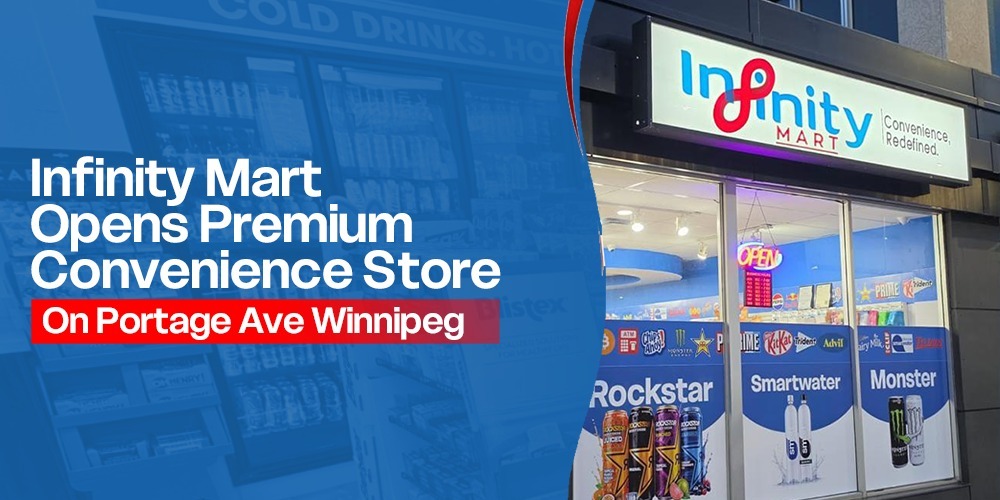
Infinity Mart Opens New Convenience Store on Portage Ave, Winnipeg
September 8, 2026

Infinity Mart Opens New Convenience Store Near Fort York, Toronto
September 2, 2026